Project gratitude
What is gratitude? What can it do? What power does it yield?
Gratitude is a moment of alchemy, where I stop pushing or trying, and an embodied feeling takes over. Then what happens next is creation.
Gratitude is not a debt; we can repay, as a creditor can demand from a client.
Knowing gratitude rests in the nerve of feeling, and feelings can’t be commanded, then gratitude refuses to behave like a proper “duty.” As it cannot be demanded. And it rests on the individual’s perception. But nor can it exist where love and honour are vacant.
And because it is free, because it doesn’t demand, it is the perfect fruitful soil for inspiration, creation, and art. And when you give back from gratitude, you give with no need of expectation. But when you can express gratitude, and it is accepted without hesitation of repayment, a smile is what you are left with. Something real is being recognised.
We have spoken a lot about gratitude, and it can feel like pure magic in a nervous system like mine when the universe tries to hold its secrets, but how do we live this? How do we walk and talk? This and that is up to a way of living. Not dependent on what one has, but on how one interacts with the world.
We can choose to live graciously, to remain open. We choose to respond with care, to carry a sympathy for others, even if we don’t understand.
Graciousness is not what we have. It is how we are, even when we have nothing.
Let’s call it old-fashioned, I call it a GRACIUS – STATE OF MIND.
See below WAO followed by The Blide Trust
WAO
I dream of a new mythology for women: heroines who are no longer prizes but creators of their own narrative, like selkies, sirens, and witches. I can only hope the painting becomes a modern myth in visual form, with the Cup-Bearers as guardians of care, sovereignty, and wisdom.
STATEMENT FROM THE ARTIST ON THE
LEGEND OF THE LACED CUP-BEARERS.
At the deepest layer are the old lands of Orkney, the strong shoulders of Hoy, the proud stones of the circle, women moving beneath the sun. This is the home of Women’s Aid Orkney, where we preserve what is sacred and restore magic to burdened hearts.
Just above this layer, the red-caped heroine, drawn from the figure of the red leader, becomes a witness. Her red leather jacket says: “I have been weathered, and I am still here.” Where ancient heroines wore cloaks or breastplates, today she wears modern armour: a symbol of survival made visible, of a woman who has reclaimed her body, her voice, and her future.
Above the heroine, the purple of the Women’s Aid logo embodies respect, honour, and sisterhood—a celebration of care and the beginning of a myth for future generations to learn from.
All this covered in lace!
Lace stands for the endless labour of women: time, patience, endurance, fine and elegant, made thread by thread, resilient, functional, and beautiful, surviving across ages through care and strength.
The colours and shades hold diversity, change, and difference, as well as unexpected encounters, pain, and healing. Pastels glow softly, fluorescents flare, metals shine to guide, and some simply dazzle for the joy of being seen.
To finish and hold this myth, so it may endure as the work of Women’s Aid does, boat varnish amber holds what the earth has given, preserving memory.
I made the painting to honour, remember, and mythologise care, to witness resilience and endurance, to reclaim narrative for women, to make the invisible visible, and to hold your own journey alongside that of others. This is simultaneously a personal act of growth, a mythic statement, and a tribute to communal labour and courage.
“With thanks to the Laced Cup-Bearers, ‘Women Aid’ through whose care we meet the Knight of Cups within and discover the magic of self-love.”
By Elke T.B. Stevens
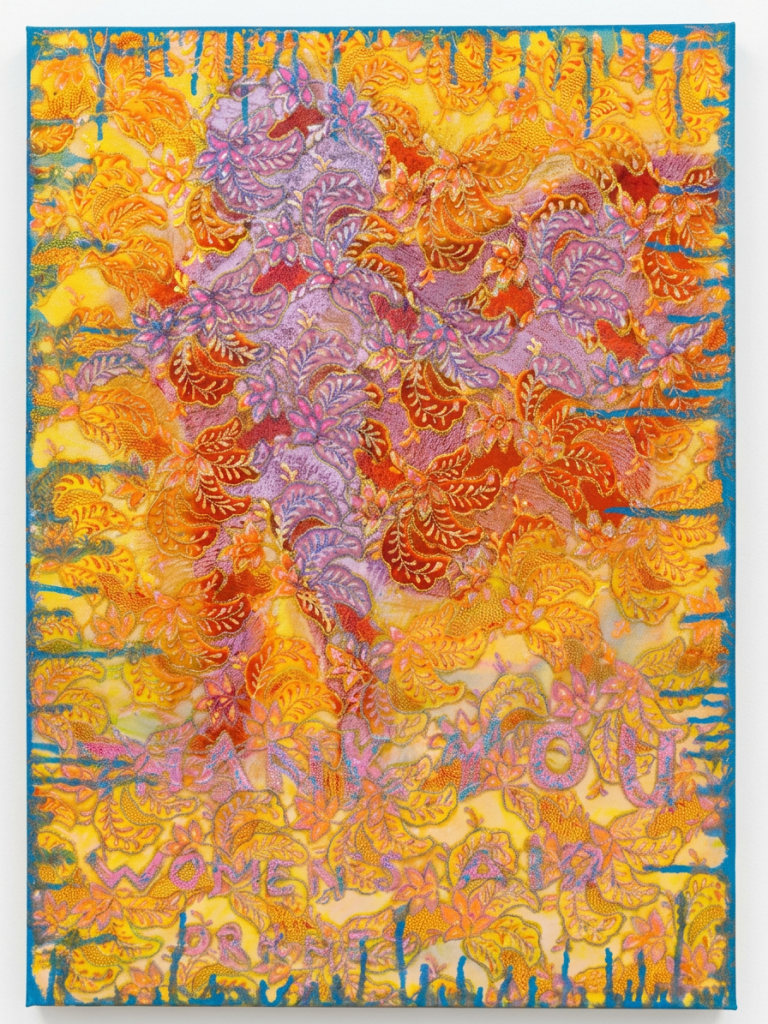
LEGEND OF THE LACED CUP-BEARERS.
On the old lands, where stone stands proud, and water keeps its own counsel, there arose an order whose work was neither conquest nor cure.
They were known as the Laced Cup-Bearers.
Their cups were not forged, but bound. Wrapped in lace made by patient hands, thread by thread, repair by repair. Lace that holds through tension, that survives by pattern rather than force. What they carried could not be dropped, yet could not be sealed away.
They moved without armour.
No swift sword-hand was needed.
Their protection was attention.
Their strength lay in staying.
They did not promise restoration. What was broken did not always return to what it was. The old order did not always rise again.
Yet healing was the due.
Paid in time, in listening, in the long work of remaining with what would not mend cleanly. Healing that did not erase the wound but allowed life to gather again around its edge.
They were heirs to the old image of the cup-bearing knight who crossed uncertain waters. But the land altered the image. The work became collective. The cup passed from hand to hand, laced and re-laced, so no one bore the weight alone.
This was the remembering of the mother-line:
Not rule, but guardianship.
Not silence, but careful speech.
Not rescue, but balance.
The land of Orkney knows them.
Stone accepts their steps.
Thread remembers their hands.
By Elke T.B. Stevens
AND WHEN THE OLD MYTHS TURNED, THIS WAS SPOKEN
This is the age when women create their myth and are no longer the treasure of the hero but step out of subordination into the age of heroines.
No longer are her days spent in ignorant goodwill, nor with a voice polite, full of meaningless words, shaped only to please her companion.
She is the woman who spoke of new stories she needed to tell, for the life lived outside the myth of the man.
She is the selkie who found her skin.
The siren who found her voice.
The witch who reclaimed the truth.
Her wildness is not reduced.
Her mystery of person is celebrated.
No longer will her landscape be tamed or controlled.
Her image is reflected back to her in beautiful, fractured, laced gold.
For a time, she travels with unknown companions.
She meets shadows that are not her own, terrified by life’s unpredictability.
Then the mist lifts.
The land’s ruins lie bare.
With the help of the Laced Cup-Bearers, sovereignty is reclaimed.
Freedom welcomes serenity and peace.
Elegance and grace return, not as ornament, but as truth.
And she journeys on, not rescued, but accompanied, with the Knight of Cups.
By Elke T.B. Stevens 2026
The Blide Trust
“The mind has long been a place where unseen winds move.
In old words, they spoke of fairy blasts, fairy sleep, and fairy strokes from the unseen world. Today we know these storms differently, yet the mystery of the inner landscape remains.”
The painting’s statement – The Blide Trust
I came to The Blide Trust through a police referral.
At that time, I arrived as someone in need of support, safety, and understanding.
What began as victim support slowly became something more.
Through my time at The Blide and with the support I received, I was given space not just to cope, but to begin to understand myself. Especially through my journey with autism, I was met with grounding, patience, and a kind of care that did not try to change who I am but allowed me to explore it.
This experience became a process of self-discovery.
The painting reflects that journey. It holds the complexity of mental health, the intensity of inner experience, the colourfulness of the unspoken parts within autism and its unpacking. Moving from overwhelm toward something real and grounded.
It is not a finished piece, because the journey itself is ongoing.
The Blide is more than a place of support.
It is a place where I began to return to myself.
Elke T.B. Stevens 22/03/2026
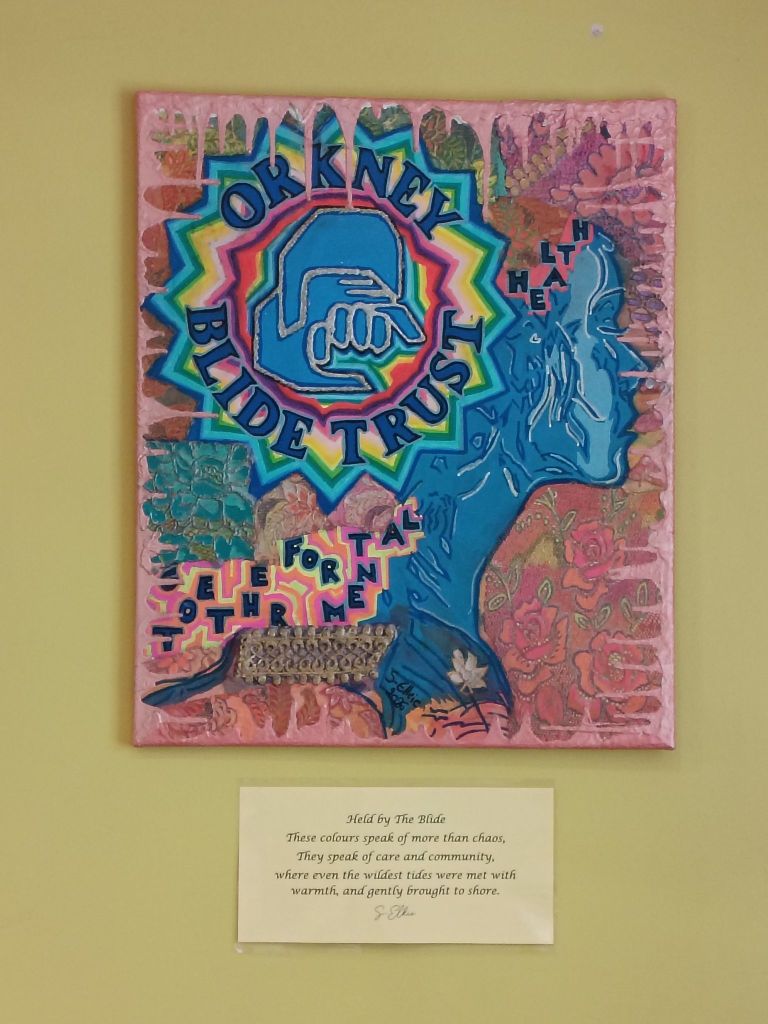
A mind’s landscapes and the bright community energy
When the Kelpie arrives in the dream of the wanderer, with the wild, untamed forces of nature and emotion, it pulls the unaware beyond their own shores of mind. It’s there the Fir Falgae, “the ones beyond the waves”, listen to the words of the one fighting the Kelpie. After the fairy winds set in, we sail to a place where unseen winds move, once thought to be the passing of the Sìth, as the mind spoke a different myth. I speak of Kelpies, fairy winds, as if they are old stories we don’t already know, the myths of old, which were the stories of visitors who wrote and invented the words you read.
These visitors came with the airy wind, according to some; a sudden gust of wind with no obvious cause was the work of the fairy wind. But the writer and the reader know that the mind is its own universe, with its own stories.
As if it is only time that will teach us to find meaning in a landscape with no cauldrons, and where life is a survival battle between the three faces of the Morrígan. And yet she will be waiting, counting the turning of the tide.
And with the Trow we travel under mounds and hills in Orkney, a dark but necessary descent. With fear of daylight, it is no wonder that one suffers from a morbid, gloomy, sorrow-tinted, shadowy nature. Even melancholy and mould could start affecting the mind when one hides from the pleasure of spring.
Waiting, hiding under the mounds and hills, was a druid who teaches others to become alchemists of their internal experience and gives them the adder stone, “the glass ball or amulet possessed by druids, either for mysteries or ornament”.
After a last dance under the crescent moon, the last moon magic of the season is being cast. Now, the pain is alchemised into the power of poetic insight. And after her stay at the guest house, the Awedyddion, our student bard, learns to grow from manic to regulated.
And a bright community gathers near the broch, dancing in a field full of Cockalowrie, as the sun beams its rays upon the Arby on the cliff nearby, scaring the last bockie out of one’s mind’s web.
I came as a victim, but I found my skin.
The Blide is more than a guest house, where a door is always open, the garden protected by its Boortree, where there is no need for cat’s fur, and the hero returns within himself.
Elke T.B. Stevens 22/03/2026
 Elke's Heart